Tuesday, April 25, 2017

FJ Holden at the Half-Way House


Like most people, Australians like to believe in their legends about themselves, and part of that legend is the Australian-made Holden car. The first of these to roll off the production line in 1948 were modified Buicks, and they were wonderful cars, immediate best-sellers with customers patiently waiting months for delivery. Simple, reliable and very strong, with a straight-six engine, they were a perfect choice for our rough roads, many of which were dirt.


This diorama is just a fantasy based on what one happy family did as soon as they got their FJ Holden — they took it for a long drive in the country. Here, they're a long way from the city, stopping at "The Half-Way House" to fill up on petrol and buy some petrol, food and drink. A few of the locals are quite happy to just look at the shiny new car, something they don't often see out the back of beyond.


The 1/43 scale model car used for this diorama is by AutoArt, and it's one of my favourite models, really nicely made with attention to detail including "steerable" front wheels which can be moved from side to side, to suit the pose you want for it. It even feels like a good quality item in your hands.

Now, for whatever reason the "FJ" name has come to be the one that general folk who aren't car enthusiasts give to this early series of Holdens. The first one was the 48/215, a forgettable name that most people now call the "FX". It was produced from 1948 to 1953. Then came the FJ, produced from 1953 to 1956. 


Finally, to give you some idea of how much the original background photo changes in one of these Photoshopped dioramas, here's the starting point. I've renovated the shed, fixed the windows, added a nicer door frame, lots of ads, a petrol pump, people and more. All in all by the time I had finished altering the original image, I had 28 layers open (each representing an alteration or addition) in Photoshop. 

The one thing I didn't alter was that fantastic roof. It's an Australian classic, just like the FJ Holden itself.

Tuesday, April 18, 2017

A lot of local colour in Italy


It's been quite a long while since I have created one of my dioramas in Photoshop, but lately I've been inspired to break all the traditional diorama-making rules once more.


It's called "Local Colour in Italy" and it was inspired by spotting a photo of some very colourful houses in Venice. For the diorama I have done the unthinkable and have removed the canal, some gondolas and other boats, and replaced them with a road. Sacrilege!


Then I decided that two-toned cars would look perfect in this street, so the one up front is this Alfa Romeo 1900, a fairly OK model by M4. The paint job isn't that great, but I like the overall look of the car despite that. 


And the one behind it is a Wartburg 311 Coupe, a much nicer diecast model by Altaya. For a cheap model, this looks great on the shelves.

I always like to include some movie stars in my dioramas, even if they are so small you can barely recognise them. This one has Saorise Ronan, Brigette Bardot, David Niven and Jean Seberg. The other cast members are humble extras roped in for the day.


Monday, April 10, 2017

Hello, Instagram


Well, I've joined Instagram, and you can find me at

@jamiedioramas

and I'll be concentrating on posting my dioramas ...


... including the ones I create in Photoshop (above), using my little model cars ...


... and the more traditional 3D ones I build the old-fashioned way.


So if you're already following other diorama makers, or diecast collectors, on Instagram, pop on over to my feed when you get a chance and say hi.


Monday, April 3, 2017

1930s Art Deco street scene diorama


It's been a while (six months!) since my last post here at "The Die is Cast", so it's time for an update on what I've been up to. I've been building a model of a bus and a car, both from the Art Deco era, both from Europe in the 1930s. They're all part of an Art Deco themed diorama I am slowly putting together.


This is a little built plastic model of an Opel Blitzbus, the Strassenzepp Essen, or road Zeppelin. This actual bus was built in the 1930s, and was used notably to ferry around competitors at the 1936 Berlin Olympics, as a showcase of the modernity of those Neanderthal Nazis.


The plastic kit itself is by a Ukrainian company, Roden, and it's moderately OK (main components fitted together) and moderately crappy (dreadful decals), too. But it's the only Art Deco bus kit I can find. Love those fins! The people in the bus aren't part of the kit. I added some 1/72 Airfix plastic soldiers as "passengers" in my Blitzbus. 


To give you an idea of its size, the bus is about as big as a 1/43 scale car, maybe a bit smaller.


The other vehicle in my diorama will be this 1/72 scale Tatra T87, from a plastic kit made by Attack Models. Attack is a Czech company, but for my money I group them with the Ukrainian and Russian companies for quality of everything from castings to decals. The good thing about these people is that they make models of cars, planes etc that suit my quirky tastes. 


The model kit was for a WWII military Tatra T87, but it was close enough for me to make it into a nice, silver, civilian one.


The bus was first produced in 1936, and the Tatra T-87 first appeared in 1936, so both are nice and new and shiny, and I love those fins on both of them.


And this is an Art Deco theatre that's in Tasmania. I am planning to build this in 3D using foam board, so this photo is simply my reference guide. I figure that for a beginner, three holes and lots of straight lines should be all I should attempt ...

I've made some progress since this posting, but I will save all that for an update next time I get a chance to do it.


Saturday, October 15, 2016

My dioramas become art for sale


Last Thursday (October 13) was the opening night of a new art show in Gaffa Art Gallery in Sydney city where my digital dioramas made their debut in the world of art.

And I sold a few! Well, to be more accurate I turned my dioramas into postcards for sale, and we've not only sold most of the first batch of postcards, we're printing some more to keep up with demand.

At the end of this blog posting I'll provide some details for Sydney readers who might be interested in dropping in not only to see dioramas in an art gallery, but also the wonderful paintings by my wife Pam and her good friend, Margaret. For people working in the city, the Gallery is near the Town Hall and open Monday to Saturday.

Right now, here's some photos of the opening night, my "installation", and then a small sample of the dioramas included in my installation.

My installation consists of a cute retro TV set that contains
a tablet device, and into this I have slipped a USB stick loaded
up with my 26 best dioramas (I have about 80 or so to choose
from). The display is a simple slideshow, with all sorts of
random fancy dissolves, etc.
The little retro TVs are made by my wife's picture framer,
Koru Studio in Enmore Road, Enmore. www.korustudio.com.au
My little installation was a sideshow, of course. The main
reason for the show is the paintings done by my wife, Pamela,
and her good friend Margaret. As you can see, the opening
night attracted a great crowd, and they managed to sell a
good number of paintings as well.

Now, for a change of pace, here's a small selection of several dioramas that were in my installation. Most of these were turned into postcards, and it's lovely to think people actually wanted to buy my work.


Abarths at Monza, 1957


Nixon and Brezhnev at a Peace Conference at Gleneagles in
Scotland. The car on the left is a Zil limousine, and the one
on the right is a Merc 600.

Boppin' at the Diner. Livvie and John in the foreground,
Marlon Brando with a Vincent motorcycle in the background.

Auburn Golden Fleece Servo. The background is a black and
white photo which I then colourised. The red Holden is a
not very nice 1/76 model, the yellow Holden a very nice
1/43 model by Trax.

Marching Band Practice Holding Up Traffic in Rome.
Marcello Mastroianni driving the Fiat 1500 Gina Lollabrigida
in the Lancia Fulvia behind.

Mr Lothario in his Speedboat on the Italian Lakes.
This model is a 1/35 plastic scale kit of a Russian military
speedboat, which I have converted into Mr Lothario's runabout.
The fake water and wake is a 3D diorama of my own making,
while the photo is merely one stuck on the wall behind.

An action shot! Peugeot 203 at Phillip Island. The driver
in this one is Jack Brabham, originally in action in a Cooper
at the 1959 Monaco Grand Prix. With its blurred background
the original shot had a Honda car in it; I photoshopped out the
Honda and replaced it with the Peugeot, which carries the
correct livery for the Peugeot 403 which came second in the
first ever Armstrong 500 in 1961, at Phillip Island.

Prince Valiant. The charming couple with their Valiant is
Carey Mulligan and Peter Saarsgard from the film
"An Education". The original milk bar is in Melbourne.
Suburban Status Seeker. The background photo actually is
that colour of house. Wonderful. The little cars are both
1/43 scale models by Trax.
 
As I mentioned earlier, there are 26 dioramas in the installation, but I guess these ones here are among my favourites.

I have to admit it was a very nice thing to have all sorts of people checking out my dioramas in this way, and talking to them about how they are created, and so on.

What they all seemed to like about them, apart from their realism, was their sense of innocent fun, which is exactly what I have been aiming for all along. Thanks everyone!

SHOW DETAILS: Gaffa Art Gallery, Level 1, 281 Clarence Street, Sydney (it's close to the Sydney Town Hall). The show is on until October 24, Monday to Friday 10-6, Saturday 11-5, closed on Sunday. www.gaffa.com.au


Sunday, September 25, 2016

Australian Rally Cars of the 1950s


Well, to conclude my epic adventure into 1950s Aussie model- and diorama-making, I thought a final summary showcase would be in order. So, pictured below are the real 1:1 cars that did a long, long arduous lap of Australia (or at least some of it) and on the right the little 1:43 scale model I created for my dioramas.

As usual, click on each photo and it will come up a lot bigger for you.

On the left, 1953 Redex winner Ken Tubman in his Peugeot
203, and on the right, my little plastic version of it, built from
a Heller kit.

On the left, Possum Kipling crosses the finish line in the 53
Redex in his 48/215 Holden, and on the right, the modded up
Trax diecast car.

On the left, the Cinesound Film Unit Peugeot 203, which
travelled all 6500 miles of the 53 Redex, to bring regular
newsreel reports to cinema-goers in the age before TV.
On the right, the Solido diecast model, heavily modified.


On the left, Wilf Murrell and Alan Taylor cross the finish line
of the 1956 Ampol Trial, which they won in their Peugeot 403.
On the right is the plastic Heller model I built.


On the left, Jack Witter in his VW Beetle, which DNF'd in
the 56 Ampol, and on the right, a Lledo diecast model
with lots of mud and other modifications.

On the left, the Davidson family's Morris Minor, which also
DNF'd in the 56 Ampol, and on the right the Corgi diecast
model, trying to look the part.
  

Tuesday, September 6, 2016

The 1956 Ampol Trial dioramas


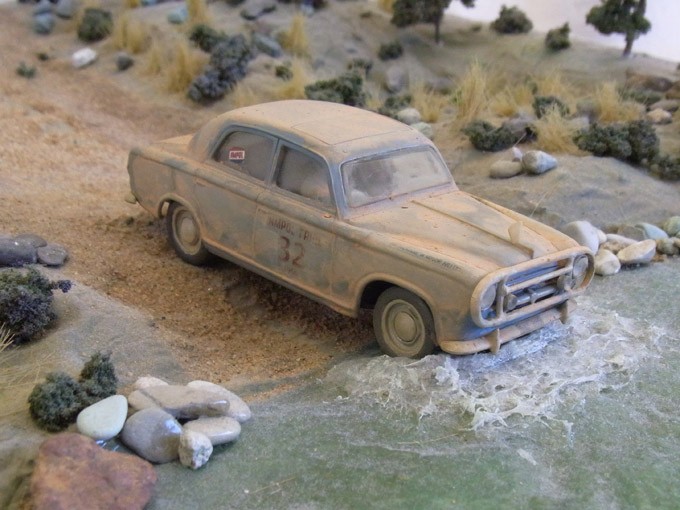
It's 1956, and the Ampol Reliability Trial, yet another of the round-Australia rallies testing the endurance of ordinary family cars, is underway, and it is generally regarded as the muddiest, toughest, and most punishing of them all so far. Heavy winter rain has turned hundreds of miles of barely formed Outback tracks into mud-wallows. And once the cars get through that muddy hell there's the prospect of countless swollen creeks to get through. We've positioned our camera team at a river crossing in outback Queensland ... let's watch them come through, one by one.

Morris Minor Series II
First car coming through is the Morris Minor, driven by father-and-daughter team Cyril and Lesley Davidson in the car sponsored by Zane's Drive Yourself Cars, the car rental garage in Melbourne where Cyril works. While they got through both the mud and this swollen creek, eventually their engine packed it in at Cairns in far north Queensland, and they retired after a wonderful effort.


Volkswagen Beetle
While Volkswagens distinguished themselves throughout the Australian long-distance rallies, for this next car through the creek crossing, the 1956 Rally wasn't a big success (although it was in second place overall earlier on, at Alice Springs in Central Australia), as this VW also retired at Cairns. However, the experience paid off in the long run, as the driver of this VW, Jack Witter, won the 1957 Ampol Trial in a VW Beetle. And even in this 1956  Ampol Trial the other VWs entered did very well, led by Max Goldsmith who took out second place overall.


Peugeot 403
Having won the first of the around-Australia rallies, the Redex of 1953, Peugeot had developed a loyal following in Australia, and when the newer model Peugeot 403 came out, the field for the Ampol Trials was liberally sprinkled with Peugeots, both the tough old 203s as well as the new 403s. And Peugeot won again, this time in the car pictured here, driven by Wilf Murrell and Alan Taylor, both from the small town of Hillston, in western New South Wales.


What didn't happen?

Last of all, the original diorama I was going to make had all three cars at the same river crossing at the same time, and I changed my mind about presenting it that way here. Nevertheless, here's a few shots of an extremely crowded river crossing that very probably never happened.


Pug leads the Veedub.


And the Pug leads the Morry across the creek.


Postscript, what happened to the Aussie Rallies? Bathurst, of course!

In 1956 the Around Australia rally craze was at is peak. There were two of them that year (Mobil and Ampol), two more the next year and then two more in 1958. And then they ended. The 1958 rallies barely caught any media attention, and so they fizzled out. However, the idea of endurance testing ordinary family cars never went away, and in 1960 the idea which eventually evolved to become the famous Bathurst 1000 was born.

At the old Phillip Island track in 1960, the first "Armstrong 500" endurance race for stock family cars was held. It was won (controversially) by a Vauxhall Cresta, with a Peugeot 403 second placed on the same lap. Australians loved to see their own family cars driven at speed, tested to the max, and the idea of sitting back at home, watching them do it on TV for one whole Sunday every year, proved wildly popular. It wasn't long before the Armstrong 500 moved from Phillip Island to Bathurst, and a motor racing legend began.


Saturday, June 11, 2016

1956 Ampol Trial diorama - update 3


The decals are drying for both the Peugeot and the VW Beetle. I apply a special stuff called Micro-Sol which effectively dissolves the decals onto the surface, and they crinkle up a bit in this process, but they should look OK by the next morning. The Peugeot, of course, is going to be splattered in so much dust and mud that you will barely be able to see the decals (and all the many other blemishes on the model itself.) 


 Ditto all those comments with the VW. The real historical VW had white-edged decals, which I can't produce on my laser printer. So I have stuck to the outlined font, but have made it red. The "Ampol" decal is actually two laid on top of each other. I have white-backed decal paper, so I've laid down a rectangle of white, and then the Ampol logo on top of that. Hopefully it will work.


I have very few reference photos for Jack WItter's 1956 VW, so I am making things up here. However, as he won the 1957 Ampol Trial there are plenty of photos of that car, and it was absolutely plastered with graphics. Jack owned a "waste textile" factory (I think that's a polite way of saying "rags") and so he promoted himself in both 1957 and 1958 with "Witter the Waster" slogans, so I figured he might have used that line in 1956, too.

Oh, and as you can see, I've left the rear split-screen window in place. I decided in the end that cutting off the divider in that section would not only be a lot of relatively useless work, given that in the diorama the VW's front is facing the viewer; it would also be a problem to smooth off and repair the cut section and then match the paint job with that nice green colour. So an "incorrect" old Veedub it remains.


The last part of the diorama has arrived, the Morris Minor. It's a pretty ordinary little Corgi Morris 1000 from the 1960s, and the eBay seller has added some extras, including windscreen wipers, an exhaust pipe and some shaky hand-done paintwork here and there. As I plan to mod it further then fling mud at it later on, it's a perfectly good starting point, especially as it cost less than two pounds, plus a few quid for postage.


The radiator grill was matt black, not the look I wanted — I wanted the horizontal bars to show up a bit, so I gently sanded it with 600 sandpaper and the bars came up well enough for my needs. Then I searched through my spare-parts bin of old sprues and leftover bits of photo-etched metal bits and got lucky, finding a very nice looking candidate to "split" the windscreen in two, just like a Series II Morry Minor. The eBay guy's windscreen wipers were easy enough to flip off with a scalpel point, so I then repositioned them so they looked very Series II as well.


Here's the three cars, ready for their adventures in mud-world.