Showing posts with label diecast motorcycles. Show all posts

Sunday, January 1, 2012

Holiday season snacks

Let's face it, far too many people eat too much crap all the time, but even the most conscientious people eat a bit of junk food during the holiday season. Here in Australia, with the festivities taking place in the middle of summer, the temptations to eat ice-creams, hot dogs, burgers, chips and other threats to Western Civilisation are just about everywhere – at home, at the beach, out on the street – we're surrounded by it. And so I thought I'd do a little diorama celebrating World Junk Food Day, whenever and wherever it occurs.

The models used here are, on the left, a 1:76 railway scale model from Oxford Diecast, of
Bob's Hot Dogs (with a suitable bunch of healthy young people about to be led astray).
On the right is a 1:43 Premium Classixxs model of a Gino's Gelato sidecar outfit, powered
by a Zundapp Bella 204 scooter.
Now, I've always been a bit of a scooter fan – owned one a one stage and have ridden many, and so there was always going to be room for scooters in my diecast cabinets. As soon as I saw my first diecast scooter with a sidecar attached I decided they were what I wanted to buy, and so far I have managed to accumulate three of them.

On the left is the Zundapp Bella Gelato seller, from Premium Classixxs. In the foreground
is an old Matchbox Lambretta, in play-worn but OK condition. I got quite a shock when I
ventured onto eBay to find one of these. In mint condition, in an original box, they can fetch
over $200. My price range is more around the $20-$30 mark, and so the trick is to buy one
that is a bit knocked about, not in its box, but still looks good from three feet away.
I finally found this one for about $30, and it's great. In the background, at the right, is a
dreadfully botched job (by me) of assembling and painting a 1:43 white metal kit of a Vespa
with a Swallow sidecar. If you're not familiar with the Swallow name, go look up the
history of Jaguar cars and you'll find they started out in life (in the 20s & 30s) as
coachbuilders, and one of their lines was sidecars for motorcycles.

Finally, an action shot of me on a Vespa PX 200E, back in the 1980s. This isn't the scooter
I owned – I had a Honda Lead 125 for several months – but I loved riding Vespas when
I got the chance. They reminded me of the big twin BMW bikes of the times: very very
solidly built, with clunky gearboxes, quirky but basically sound handling once you learned
to ride it right, a grunty engine and a comfy seat. 
 
There's a whole fascinating history behind Vespas which I guess I can make
the subject of a posting here one day, but right now that's it from me. I think I have a bit more junk food to eat. It is the holiday season after all!


Tuesday, February 22, 2011

Italian V-twin melodies

I love the sounds some motorcycles make, but I am picky about bike noise too. Not all bike sounds please me, but I do love a good Italian V-twin melody pretty well all the time. The best place to enjoy these booming arias is when you're sitting on the bike, and it is powering out of a corner, up a hill, preferably a good, long hill. And I do enjoy it when my own Italian V-twin does it. It's one of the simple pleasures that a motorcycle offers in bucketloads, when compared with most cars and their muffled engines. And so today's little posting is going to end with a brief but noisy sound check, but before we get to that I thought I'd show you a couple of photos of Italian V-twin melody makers I have in my diecast model cabinet.


The Ducati 750SS, the 'green frame' model, probably the most collectable classic 1:1 size
Ducati there is. This one in the photo is a bit smaller; it's my little 1:24 model made by IXO,
painstakingly deep-etched into the same background I used for my earlier posting on
the Vincent Black Shadow.
This bike really put Ducati on the superbike map. With the addition of desmodromic valves to the 750cc 90° inline V-twin (which first appeared in 1972) the 1974 Super Sport gained 10bhp and 10mph in top speed, giving it a maximum somewhere around the 135-140mph (218-225km/h) mark. But it wasn’t just straight line speed that told the story, it was the ‘on rails’ handling and the sheer look and sound of the thing. In terms of desirable Ducatis from the 70s, look no further. This bike was inspired by a famous race win, by Paul Smart at the Imola 200 mile race in 1972. This SS is generally known as the ‘Green Frame’ model, as this also represented the fact that it was a new, slimmer, improved frame which offered better handling. Another little detail of note was the fibreglass fuel tank with a clear strip down the side, for a quick check on fuel levels.

This is the 'grandfather' of my own bike, the 1969 model Moto Guzzi V7 Special, presented
here as a 1:24 model made by Starline. It's not really my dream Moto Guzzi – I prefer
both the California as a cruiser, and the Le Mans as a sports bike – but this is the bike
which gave Moto Guzzi V-twins a great start in earning an enviable reputation for quality
and reliability. And I wanted a model of my own bike's spiritual ancestor.


The first prototypes of the new big Moto Guzzi V-twin appeared in 1965, using the engine which powered Moto Guzzi’s three-wheeled military vehicles. The first production models went on sale in 1967, and the V7 series appeared in 1969, as a 700cc bike at first (called the V7), but which quickly turned into the 750cc V7 Special. It made 60bhp, could get up to 115mph (186km/h) but this was a big, heavy 228kg (502lb) tourer, not a sports bike at all. And it wasn't cheap. In fact it was almost as expensive as you could get at the time.

I started bike riding in 1971 (on a very crappy BSA 250) and I always remember the Moto Guzzi V7 Special that some lucky rich guy in my suburb owned. I saw him on it every now and then, and while it was so far out of my price range that it was in the "in your dreams, son" category, I knew that I was only 18 and that hope springs eternal in a young man's breast. (By the way, the V7 Guzzis might be more familiar to North American readers as the ‘Ambassador’.)

No, this is not my best diorama yet. It's my own 1:1 scale Moto Guzzi V7 Classic (2009 model),
pictured out in the NSW countryside enjoying what itdoes best, gobbling up country roads with
ease. You can see the family resemblance to Grandpappy above, but its engine is not of the
same provenance. This 750cc twin is based on a later V-twin designed by Lino Tonti. The
original V-twins were designed by Giulio Carcano, the man who also designed that other
famous Guzzi engine, the V8 Grand Prix bike. My bike's engine has a lot less flywheel than
the older Guzzi donks,with which I have spent many miles travelling Australia's highways.
MyGuzzi's engine revs more easily, has a much nicer gearbox, too, but it does share
one thing in common with the old fellas. It makes beautiful music.

My Guzzi is nice to ride anytime. It handles well, steers precisely and it's light. It's classed these days as a 'middleweight' bike. Back in the early 70s, a 750 was about as big as you could get in a true sports bike. But it's nice to take my V7 Classic even for a short ride across town, because it just sounds so damn good at idle, taking off, accelerating, powering out of corners. Anytime, anywhere, it sounds great.

And so I should finish off with that promised sound check, courtesy of You Tube. A Guzzi Le Mans in a tunnel, then emerging from a tunnel. It only takes a few seconds, but it sounds about right to me, an Italian V-twin melody.


Wednesday, February 16, 2011

Vincent Black Shadow

As well as mostly collecting diecast cars, I have a small collection of assorted motorcycles, most of them in 1:24 scale, and one of my favourite models is this one, the Vincent Black Shadow. But it's not a perfect model by any means. 

You wouldn't believe what a time-consuming stinker of a job it is to deep-etch the spokes on
a motorcycle wheel in Photoshop, not to mention the dozens of little 'peek-through' nooks
and crannies around this machine, including those two in the rocker boxes. After more than
an hour of fiddling (and learning how to do it), here it is, my diorama of a Vincent/HRD
Black Shadow stopped to take in the views on an enjoyable weekend ride up into
the lush mountains in the hinterland, where the winding roads unfold.

So, what's wrong with this model? Well, like the Jochen Rindt Alfa which I blogged about here, this is another example of a mis-labelled model. The little plinth on this 1:24 IXO model says it’s a "1953 Vincent Black Shadow", but it’s actually a 1948 or 49 model. Small difference? Well, the badge/decal on the tank is a dead giveaway. That’s because they dropped the name ‘HRD’ from 1950 onwards, due to pressure from American dealers, who said people thought an HRD had something to do with Harley-Davidson. From 1950 onwards, they all had a ‘Vincent’ label on the tank. Like this one.


These nitpicks aside, it’s a lovely bike, a nice model and one of the all-time great motorcycles, a 1000cc, 60° V-twin that, while a tractable thing around town, was good for 125mph (200km/h) when wound out on the highway. All this in the late 1940s. No other bike came close to it at the time, or for quite some time. No wonder real 1:1 size Vincents are so pricey and sought-after. Australian bike enthusiasts all know about our connection with the Vincent. It was co-designed by Philip Vincent, owner of the company, and Phil Irving, the Australian who was his chief engineer for many years. 

However, instead of banging on with a history that's easy enough to find and read if you really are interested, I thought I'd finish off with my favourite song about a Vincent, written by and performed by one of my favourite musicians, one of the greatest guitarists alive, Richard Thompson. It's called Vincent Black Lightning 1952.

With lines like: 
"There's nothing in this world that beats a 52 Vincent and a red-headed girl" 
and "He gave her one last kiss and died, And he gave her his Vincent to ride"
it's a great story as well as a fine tune, and the guitar-playing and singing aren't too bad, either.


Monday, February 14, 2011

Swinging sidecars


Whoever whispered in my ear when I was much younger that: "It's better to regret the things you've done, than to end up regretting even more things that you never got around to doing" did me a favour. In the case of motorcycles with sidecars, I am glad that I have ridden a few of them, but I definitely regret at some stage never owning one. Getting one now is merely part of a lottery win fantasy, as I currently have nowhere to keep one and so I'd need a bigger house, and a garage, as well as the outfit. And so I content myself at this stage with just a couple of 'outfits' in my diecast cabinet. First up, fantasy outfit Number One.

BMW R69S, with a Steib TR500 sidecar. Yes, that would definitely do me! The more familiar
Steib sidecar is more of a lozenge, or bullet, shape, but this is the one which BMW offered
for sale to the public. The R69S is considered by many BMW fans to be the most collectable
of them all. A smooth, torquey 700cc engine, shaft drive, Earles forks. It's everything
a touring outfit possibly needs to traverse a continent in style. This 1:24 model
by IXO is a bit flimsy (wobbly exhaust pipes), but quite pretty nevertheless.
Not really a fantasy outfit, but it would be nice to tootle about town with one. This is an unusual
1:43 model, a white metal kit that cost 10 English Pounds, via eBay. I'm an absolute klutz
with my hands, and so the result of my glueing and hand-painting is not all that flash, but
when friends check out my diecast cabinet, this is the piece that invariably brings a smile.
The sidecar attached tothis Lambretta scooter is a 'Swallow Sprite' as far as I can tell, by
Googling. Swallow is the sidecar-making company of the early 1920s which then became
a car bodybuilder in the early 30s, then a car maker of SS cars in the late 30s. After the
Second World War the SS name wasn't all that appealing to anyone, anywhere. So they
changed their name to Jaguar. The sidecar division was sold separately around that time,
and in the 50s Swallow kept on making 'chairs' for all sorts of bikes, including the
increasingly popular scooters from Italy, such as this Lambretta.
It's interesting to read the history of companies such as Swallow and Steib. Both suffered an irreversible decline in the late 50s, as motorcycles, and motorcycles with sidecars in particular, fell from favour. Cars became cheaper, more plentiful, and sidecars just couldn't compete in that marketplace. Many people probably don't realise how popular motorcycles with sidecars were in the 1920s, 30s and 40s, often used as work and delivery vehicles as well as being family transport. I think my old Grandpa, the church minister, had a bike with sidecar to do the rounds of his country parish before he stepped up to his flash, comfy Buick in the late 1930s.

My own experiences with sidecars were limited. With an old mate of mine, we spent a memorable weekend in a borrowed Norton outfit roaring along dirt roads north of Sydney. And then, later on, while I was working as a motorcyle road-tester for a bike magazine, I was given a Russian Ural outfit to test. It was painted bright green, was a Police model fitted with a siren (you depressed a foot lever, which activated an arm which rubbed on the flywheel, and as you pulled in the clutch and revved the engine, the siren wailed away!). Alas, its electrics lasted about three days before frying, but I had three days of fun with that Russian cop outfit. The machine was picked up by the folorn dealer, taken away on the back of a truck, and my brief career with motorcycle sidecars was brought to an early end.


But let's not finish on that broken-down Russian bum note. Let's go for a brief ride on that fantasy bike of mine, the BMW R69S outfit. After the video guy goes to some trouble to prove that he's starting the bike from cold, he then does a couple of passes, including the almost obligatory You Tube flypast with the sidecar wheel in the air. Nice bike, that R69S.

Monday, October 4, 2010

Keeping it simple

Call me a traditionalist, but I like simple motorcycles. I've ridden and enjoyed bikes such as the silky smooth Honda CBX six-cylinder bike but my heart is with the singles, the twins and the simple little two-strokes. Simpler is lighter, and lighter is faster (well, sort of). Simpler is also cheaper to fix, and easier to fix for a minimally skilled home mechanic such as myself. And so my bike collection conforms to these conservative tastes. The collection is also limited to 1:24 scale bikes, as the first model bikes I bought (the Moto Guzzis) were 1:24s and so it made aesthetic sense for any new purchases to be on the same scale.

For starters, not quite simplicity itself, but at least it's a single, and it's a very
pretty one, too. The Ducati 350 single, with Desmo valve gear. While the
conventional widson is that Desmo valve gear, with its mechanical opening
and closing of valves allows high revs and prevents valve bounce, that's not
quite the whole story. The other benefit of the Desmo design is that it allows
more radical cam profiles to be used, without the threat of valve bounce.
While I couldn't find a YouTube video of a 350 Ducati Desmo, I did find this very tidy little road test of the smaller 250 Desmo, in the same colours and of the same vintage. 


Next, the BMW R90S. This is as close as I could get to the bike I owned.
This was my baby, the R100, 1000cc, low-compression model, without
annoying fairings or other heavy clobber. Lovely touring bike on which
I did a great many kilometres. And it was black. I like black bikes.
I'm perfectly happy to make do with the R90S model. This mid 70s Beemer
put BMW back onto the sports bike map in a big way. It performed very
well in local production races (especially the Castrol Six-Hour Race that was
such a big event every year during the 1970s) and won many admirers.
This 1:24 model by IXO looks like a piece of candy, and if you have a close
look at the slightly upturned cylinder barrel on the left side, it's not quite
straight. Instead of a 180° flat twin it looks about 172° to me!
It always seemed to me that to go fast on the big, open highways of Australia the most you needed to do the job well was two cylinders. A single couldn't comfortably go the distance at speed, so you did need a twin. The 1000cc twin I owned was probably more than enough to do the job. Other friends had 800cc BMWs and never lagged behind anywhere, and my current Moto Guzzi 750 would do any trip in style. 

However, as I spent most of my time in the city, I rode sporty little two-stroke bikes for many years. And I discovered that the little two-strokes could handle the open highways very nicely, especially those along our long coastline and up and over our mountain ranges.

In the same way that the BMW R90S represents other bikes which I owned
and loved, this Yamaha RZ250 has to deputise in my collection for the
air-cooled and water-cooled Yamaha 350s which I spent a lot of time on.
On the right open road, one with a good number of corners, a Yamaha 350
could take on any bike and acquit itself well, especially during the 70s and 80s,
when the roadholding of most of the big Japanese fours was suspect. As for
the big British twins of the era, they didn't stand a chance against a Yam 350.

To finish off the little bike collection, one I never owned, and this one also
is deputising for the bike I really wanted. This is a 1970s version of the
Spanish Bultaco Metralla, a single-cylinder 250 two-stroke.
This is the Metralla I want in my collection, the 60s era bike. Simplicity itself,
very sporty, too. On my very first day of riding a bike on my own after getting
my "L" plates, I came across a friendly old guy on a Metralla who had zoomed
past me at an alarming lean angle earlier on. We both stopped at the same
petrol station, and I was amazed to see him fill the fuel tank, add some
two-stroke oil to the tank, then pick up the front end of the bike, give it a
few vigorous shakes to mix it all up, then he sped off. Of course I wanted one!


And so to finish off this little diecast homage to bikes I have owned and ridden, here's a chap eventually succeeding in getting his 60s era Bultaco Metralla started, but not without a good struggle at first. Sporty two-strokes – sounds like an evil genius cackling!


Saturday, September 25, 2010

I blame you, Carlo Guzzi!


Poor Carlo Guzzi has been resting in his grave since 1964, but he's the one who is responsible for me taking up diecast collecting. The story is a simple one. In May this year, after quite a long break, I returned to motorcycling, buying a Moto Guzzi V7 Classic 2009 model. Then I thought it would be nice to have a diecast model of the V7's grandfather Guzzi, also named V7. I liked the model so much I bought two more, and then some cars, and now look where I am. Blogging about diecast cars and bikes. Rest in peace Carlo, but you started it!

Here's the Starline 1:24 model of the V7 Special
sitting on the rocker cover of my V7 Classic.

And here's the V7 Classic. 750cc, retro-styled and
a very nice bike to ride. Lovely exhaust note, too.
I've ridden several Guzzis over the years, but
never owned one, so it was top of my list of bikes
to buy if and when I started riding again.


This is the Starline model of Grandpappy. This original bike, the V7 Special,
first appeared as a 750cc tourer in 1969. I wanted one even back then, but
as a poor, snotty schoolboy it was way out of my league.
These Starline models are nicely done. The company has been good to deal
with. You can find them online at www.starlinemodels.com They specialise
in just a few bike and car makers. Very much the small specialist outfit. 
If I won the lottery and could get my hands on any bike I wanted, I'd get
a real one of these – the Moto Guzzi Falcone, a 500 single. In the
meantime, I'm happy to just have a 1:24 Starline model of one.
I've always like fishtail exhaust pipes, so that's a bonus, and it is a Carlo
Guzzi bike. But the other great thing about Falcones is the cool videos
they have inspired. And so it's video time folks, courtesy of You Tube.


And the simple pleasures of a Guzzi Falcone idling.


But wait, there's one more (bike, not a video), a great bike that is forced to live in the shadow of a famous failure of a big, noisy brother.

This is the 350cc Moto Guzzi GP bike which won the World Championship
in 1953, 1954, 1955, 1956 and 1957 (in that last year with Aussie Keith
Campbell in the saddle). A simple little single cylinder bike, the genius
of Carlo Guzzi is very much inside every nut and bolt.
This is of course another 1:24 Starline model, and they call it the Bialbero,
a name I hadn't heard of previously. While these little bikes' top speed
was varied to suit the gearing of each circuit, at the fastest circuit in Spa
Francorchamps in Belgium, they reached 140mph (225km/h), an amazing
speed for a humble little 350cc horizontal single-cylinder four-stroke.
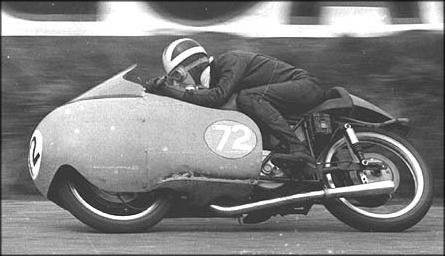
Here's the 350 in action at the time. And this gives me the perfect segue
to introduce its famous big brother. I found this photo above of the
350 on Google Images, and at several other blogs and websites the same
mistake is repeated: they all say this is the Moto Guzzi 500 V8 in action.
No it's not, it's the 350. Check the exhaust pipe on this bike, and the model above.
The same. Check the V8 below, in the Moto Guzzi museum.


The 500V8's exhaust plumbing is reminscent of spaghetti, but there's no
way a single long pipe is poking out the bottom of this machine!
So it's the fate of the very successful little Moto Guzzi 350 single to live in the shadow of the 500V8, which captured hearts and imaginations but very few prizes. Starline Models of course has a 500V8 in its 1:24 model lineup, but I didn't order one. I'm sticking with my little mate the 350. It'll do me.