I have a major soft spot for all working vehicles, the unsung heroes that keep society ticking over while the flashier creations get all the attention. Of course taxis do have the allure of their various paint colour schemes, which are usually meant to make them stand out from the crowd on a busy street, and in that way they aren't always the height of good taste. They just stand out so customers can spot them easily. However, I will start with one little taxi which is as cute as a button in its own right.
Citroen 2CV taxi, model by Norev. Pure charm.
What a delightful weirdo! A Russian Vniite cab. Not sure how many made it onto the streets, but it would be fun to cruise around Moscow or St Petersburg in one.
Hindustan Ambassador, descendant of the Morris Oxford, the Indian taxi the lads at Top Gear say is the greatest taxi in the world. This neatly detailed model is by IXO.
Here's what I mean about paint schemes making the taxis easy to spot in a crowded street. These are all Paris cabs.
Panhard Dyna X. Love the luggage.
Panhard Dyna Z. All it lacks is luggage!
Panhard Dynamique. I also have a "civilian" non-taxi model of this car, and the taxi is by far the better looking thing.
Peugeot 203.
Peuget 403.
Citroen DS 19, the smoothest ride of all of them, I am sure.
Peugeot 404, one of my first little dioramas from way back.
Another old diorama of the Austin FX4 in London.
Ditto, an early dio of the New York Checker cab, driver hungry.
Casablanca cab, driver also hungry.
A Tuk Tuk, driver perhaps seeking religious solace.
Watching the Dakar Rally highlights on TV each night has partly inspired this posting. In my diecast cabinet there are a few French cars from the 60s and 70s that thoroughly enjoyed a bit of good, dirty rallying fun, and did pretty well, too. Here are some of them.
The Citroen DS21, which was the moral winner of the 1968 London to Sydney Marathon.
Just 98 miles from the finishing line in Sydney, drivers Ogier and Bianchi were so far in front
they were uncatchable (if nothing went wrong). On a stretch of road that was supposed to be
closed to the public, the Citroen had a head-on collision with a Mini (reputedly driven
by two off-duty policemen). The Citroen was wrecked and Bianchi badly injured. Paddy
Hopkirk, who was coming second, arrived on the scene in his Austin 1800 and threw
away his chance of winning the event by turning around and going for help. That left
Andrew Cowan, in a Hillman Hunter, the winner. But that DS21 became part of Citroen
legend, one of the greatest Citroen feats ever. This model (1:43 by Atlas) is parked near
Uluru (Ayer's Rock) in Central Australia, but the London-to-Sydney route didn't actually
go through here. I just like the look of Uluru as a backdrop for my DS21.
This 1:43 Norev model is the Peugeot 404 Injection which Bert Shankland drove to victory in
the 1967 East African Safari Rally. Bert, a Peugeot dealer from Tanzania, was the man to beat
in those days. He won the 1966 rally, which was very wet, and the 67 rally, which was very
dry and dusty. In 1968 his car blew a connecting rod 150 miles from the finish, while he was
insecond place, rapidly reeling in eventual winner Nowicki in, you guessed it, a Peugeot 404.
There's a great quote from the Aussie Frogs websitewhere I found all this good info, about
the 1968 finish. "On the ramp at Nairobi the (second-placed) Huth Ford Lotus Cortina was a
mess. Its door pillars were cracked. Its windscreen was held in place with rope. It had no
clutch, and it failed a brake test. In contrast the Nowicki Peugeot looked all ready to go
around again." The Peugeot teams always went for toughness as a priority, while the
faster cars invariably seemed to break.
This is the Peugeot 504 which came in 9th place in the 1976 East African Safari Rally, the
one where Mitsubishi scooped the pool with a 1-2-3 finish in their Lancers. The first Peugeot
504 home was driven by that man Bert Shankland who came in fifth. The car pictured here
(a 1:43 model byAltaya) parked outside a Masai village in Kenya, was driven by Jean-Pierre
Nicolas and Jean-Claude Lefebvre. Just finishing was a great achievement. Of the 65 teams
which started, just 14 finished the 4950km rally in Kenya. Nicolas and Lefebvre went on to
win the 1978 Safari Rally in a Peugeot 504 V6 Coupe.
At this stage of proceedings, let's have a look at those 404s and 504s in action, in Africa. Good dirty fun indeed!
But wait, there's one more! Move forward a few years, to 1979, and the first-ever Paris-Dakar Rally, an interesting car with a great Paris-Dakar story to tell.
Here's the home-modified Peugeot 404 Pickup driven by mechanic/car builder Marc Andre and
his co-driver Philippe Puyfoulhoux. Powered by a 2-litre Peugeot 504 engine and modified to
include a larger cab (that included504 seats), the Pickup took 1000 hours of work to look
this good. (I'veplaced this 1:43 model by Norev on a rocky hillside in the Atlas Mountains).
How did it go? Brilliant and bad, I'm afraid. The bad news is that sand got in via the timing
pulley, and they had to pull out. The brilliant news is that they repaired the engine and
continued directly to the finish at Dakar. Once there (ahead of all the competitors still in
the race) they entered Dakar legend on the final day, at the last stage of the rally on the
beach. Thierry Sabine, the event organiser, asked Marc Andre to open the track and warn
the public that the competitors were coming soon, and of course the crowd lining the
finish, including press photographers, went wild, thinking the 404 Pickup had won! I found
out all about this car at a French website (use your Google translator) and forum, which
You want an acid test for a car? Put it to work as a taxi, that'll soon tell you whether it's well built or not. A lot of cars fail to make the grade, and in several cities companies have purpose-built ultra-tough cars specifically as cabs. And so my diecast collection has to have some cabs. I know there are many missing from the collection so far – no Mercedes cabs, such as the one I had a scary ride around Amsterdam in; and no Volga cab from Moscow, either – so here are just a few cabs from around the world, what I have so far.
As a theme for my cheesy dioramas, I thought a 'food' theme might be worth a try, as cabs spend a lot of their time either delivering customers to an eating spot, or picking them up from an eatery then taking them home. Of course I couldn't resist a few twists on that theme, so here goes.
Peugeot 404 Paris taxi, an IXO model. The wonderful thing about Peugeot taxis, apart from
being one of very few cabs with a Pininfarina body, is that they were almost identical to the
sedans sold to the public, and yet they toughed out life as a taxi without complaint. Though many
cabs had the normal 1.6 litre four-cylinder petrol engine, over time the majority of Pug 404
cabs used the 1.9 litre diesel engine, which first appeared in the 403 Peugeot. Roomy inside, with
comfy seats and soft suspension, the 404 was a great way to glide home from the brasserie.
In Morocco, the best way to enjoy fish is to buy it fresh from the markets then cook it at home
yourself, for lunch. Here, this Peugeot 203 cab is waiting while the customer haggles with the
fisherman down by the dock in Casablanca.
In Sydney, Australia, in 1957, life was simpler and eating out far less flash than it is these days.
Here, this Holden FE has stopped off at the famous Harry's Cafe de Wheels down at
Woolloomooloo, on Sydney Harbour. Here, the food fare is mostly meat pies, including the
'pie floater', a meat pie sitting in a dish of cooked, mushy green peas. An acquired taste. The Holden,
a GM car, was produced from 1956-58 and got along OK with its 2.3 litre straight six engine,
but as for going around corners and stopping it wasn't so hot. But it was tough and reliable enough.
The livery this IXO model wears is for the De Luxe Red Cabs, common in Sydney at the time.
Holdens have proved their toughness as taxis over many years.
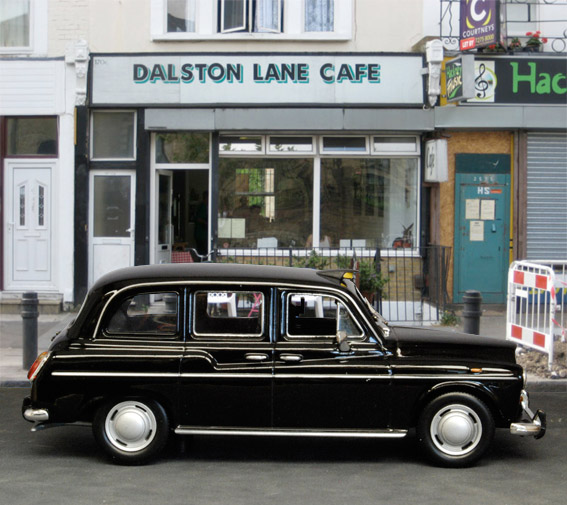
All cabbies have to eat, and this classic black London cab, an Austin FX4, is pictured outside
the cabbie's favourite 'greasy spoon' cafe. This model is made by Welly. The FX4 was made from
1958-1997, and followed on from the Austin FX3, which some aficionados love even more.
But I wanted an FX4, as that's the cab I rode in on many occasions when living in London.
Depending on which year it was made, the FX4 could have had a 2.2 or 2.5 litre Austin diesel,
a 2.3 litre Land Rover diesel, or a 2.7 litre Nissan diesel. But it was almost always a diesel,
although some petrol-engined London cabs were made. But they wouldn't have sounded right.
Of course I had to include a Checker Cab from New York, and the imposing Eveready Diner in
New York is the place to park it, for a feast of burger and fries either for the driver or the customer.
Like the London cab this American car was a purpose built taxi that changed very little down the
years. Morris Markin, the owner of Checker Motors Corporation, did sell these cars to the public
(for example, this one as the A12 Marathon), but most of his sales were to taxi companies. Engines
varied from the early 3.8 litre side-valve six, through to 4.6 or 5.7 litre V8s, petrol Chevrolet
engines mostly. However, there was a 3.8 litre diesel engine option, an in-line four made by Perkins.
And now, for a brief video interlude courtesy of You Tube, what else could I possibly include at this point but the trailer for Scorsese's 'Taxi Driver', starring Bob de Niro? That reminds me. Haven't seen it for 10 years, must get it out on DVD again.
Finally, stretching the food theme a long way this time, but the monks at this temple in Bangkok
make the best satays, they're around the back. Parked out the front is the mighty Tuk-Tuk
of Bangkok and every crowded Asian and African city and town in the world, plus anywhere
else where space and money is in short supply. You can thank the Italians for the Tuk-Tuk, as
the original version was the Piaggio Ape, powered by a Vespa engine. Engines used to be 150,
200, 250 or 350cc two-strokes, depending on the model. These days the pollution from the
massed two-strokes has become a major problem, and many now have four-stroke engines
powered by LPG or compressed natural gas. Like the rattle of a London cab's diesel, I always
remember the putt-putt of a Tuk-Tuk in Thailand.
Well, that's the very modest and inadequate taxi collection so far. I'm definitely in the market for some more. Mercedes, Volga, a Citroen DS19, more Peugeots (a 504 from sub-Saharan Africa is what I want)... hell, I might even get another Holden if the right one comes along.