Showing posts with label Morris Minor. Show all posts

Sunday, September 25, 2016

Australian Rally Cars of the 1950s


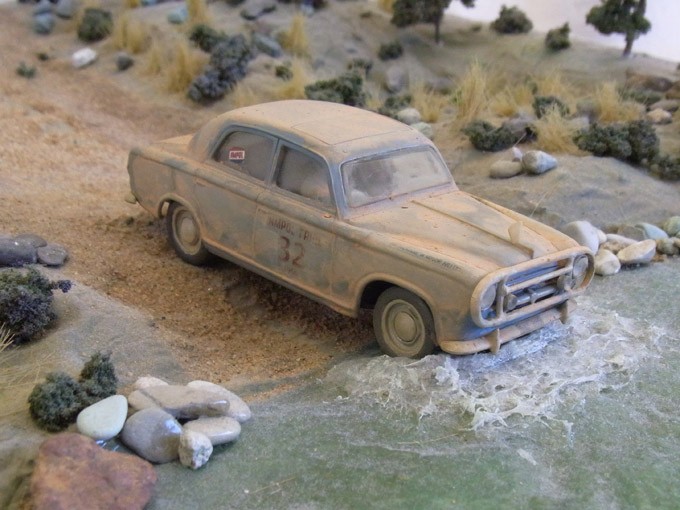
Well, to conclude my epic adventure into 1950s Aussie model- and diorama-making, I thought a final summary showcase would be in order. So, pictured below are the real 1:1 cars that did a long, long arduous lap of Australia (or at least some of it) and on the right the little 1:43 scale model I created for my dioramas.

As usual, click on each photo and it will come up a lot bigger for you.

On the left, 1953 Redex winner Ken Tubman in his Peugeot
203, and on the right, my little plastic version of it, built from
a Heller kit.

On the left, Possum Kipling crosses the finish line in the 53
Redex in his 48/215 Holden, and on the right, the modded up
Trax diecast car.

On the left, the Cinesound Film Unit Peugeot 203, which
travelled all 6500 miles of the 53 Redex, to bring regular
newsreel reports to cinema-goers in the age before TV.
On the right, the Solido diecast model, heavily modified.


On the left, Wilf Murrell and Alan Taylor cross the finish line
of the 1956 Ampol Trial, which they won in their Peugeot 403.
On the right is the plastic Heller model I built.


On the left, Jack Witter in his VW Beetle, which DNF'd in
the 56 Ampol, and on the right, a Lledo diecast model
with lots of mud and other modifications.

On the left, the Davidson family's Morris Minor, which also
DNF'd in the 56 Ampol, and on the right the Corgi diecast
model, trying to look the part.
  

Tuesday, September 6, 2016

The 1956 Ampol Trial dioramas


It's 1956, and the Ampol Reliability Trial, yet another of the round-Australia rallies testing the endurance of ordinary family cars, is underway, and it is generally regarded as the muddiest, toughest, and most punishing of them all so far. Heavy winter rain has turned hundreds of miles of barely formed Outback tracks into mud-wallows. And once the cars get through that muddy hell there's the prospect of countless swollen creeks to get through. We've positioned our camera team at a river crossing in outback Queensland ... let's watch them come through, one by one.

Morris Minor Series II
First car coming through is the Morris Minor, driven by father-and-daughter team Cyril and Lesley Davidson in the car sponsored by Zane's Drive Yourself Cars, the car rental garage in Melbourne where Cyril works. While they got through both the mud and this swollen creek, eventually their engine packed it in at Cairns in far north Queensland, and they retired after a wonderful effort.


Volkswagen Beetle
While Volkswagens distinguished themselves throughout the Australian long-distance rallies, for this next car through the creek crossing, the 1956 Rally wasn't a big success (although it was in second place overall earlier on, at Alice Springs in Central Australia), as this VW also retired at Cairns. However, the experience paid off in the long run, as the driver of this VW, Jack Witter, won the 1957 Ampol Trial in a VW Beetle. And even in this 1956  Ampol Trial the other VWs entered did very well, led by Max Goldsmith who took out second place overall.


Peugeot 403
Having won the first of the around-Australia rallies, the Redex of 1953, Peugeot had developed a loyal following in Australia, and when the newer model Peugeot 403 came out, the field for the Ampol Trials was liberally sprinkled with Peugeots, both the tough old 203s as well as the new 403s. And Peugeot won again, this time in the car pictured here, driven by Wilf Murrell and Alan Taylor, both from the small town of Hillston, in western New South Wales.


What didn't happen?

Last of all, the original diorama I was going to make had all three cars at the same river crossing at the same time, and I changed my mind about presenting it that way here. Nevertheless, here's a few shots of an extremely crowded river crossing that very probably never happened.


Pug leads the Veedub.


And the Pug leads the Morry across the creek.


Postscript, what happened to the Aussie Rallies? Bathurst, of course!

In 1956 the Around Australia rally craze was at is peak. There were two of them that year (Mobil and Ampol), two more the next year and then two more in 1958. And then they ended. The 1958 rallies barely caught any media attention, and so they fizzled out. However, the idea of endurance testing ordinary family cars never went away, and in 1960 the idea which eventually evolved to become the famous Bathurst 1000 was born.

At the old Phillip Island track in 1960, the first "Armstrong 500" endurance race for stock family cars was held. It was won (controversially) by a Vauxhall Cresta, with a Peugeot 403 second placed on the same lap. Australians loved to see their own family cars driven at speed, tested to the max, and the idea of sitting back at home, watching them do it on TV for one whole Sunday every year, proved wildly popular. It wasn't long before the Armstrong 500 moved from Phillip Island to Bathurst, and a motor racing legend began.


Saturday, June 11, 2016

1956 Ampol Trial diorama - update 3


The decals are drying for both the Peugeot and the VW Beetle. I apply a special stuff called Micro-Sol which effectively dissolves the decals onto the surface, and they crinkle up a bit in this process, but they should look OK by the next morning. The Peugeot, of course, is going to be splattered in so much dust and mud that you will barely be able to see the decals (and all the many other blemishes on the model itself.) 


 Ditto all those comments with the VW. The real historical VW had white-edged decals, which I can't produce on my laser printer. So I have stuck to the outlined font, but have made it red. The "Ampol" decal is actually two laid on top of each other. I have white-backed decal paper, so I've laid down a rectangle of white, and then the Ampol logo on top of that. Hopefully it will work.


I have very few reference photos for Jack WItter's 1956 VW, so I am making things up here. However, as he won the 1957 Ampol Trial there are plenty of photos of that car, and it was absolutely plastered with graphics. Jack owned a "waste textile" factory (I think that's a polite way of saying "rags") and so he promoted himself in both 1957 and 1958 with "Witter the Waster" slogans, so I figured he might have used that line in 1956, too.

Oh, and as you can see, I've left the rear split-screen window in place. I decided in the end that cutting off the divider in that section would not only be a lot of relatively useless work, given that in the diorama the VW's front is facing the viewer; it would also be a problem to smooth off and repair the cut section and then match the paint job with that nice green colour. So an "incorrect" old Veedub it remains.


The last part of the diorama has arrived, the Morris Minor. It's a pretty ordinary little Corgi Morris 1000 from the 1960s, and the eBay seller has added some extras, including windscreen wipers, an exhaust pipe and some shaky hand-done paintwork here and there. As I plan to mod it further then fling mud at it later on, it's a perfectly good starting point, especially as it cost less than two pounds, plus a few quid for postage.


The radiator grill was matt black, not the look I wanted — I wanted the horizontal bars to show up a bit, so I gently sanded it with 600 sandpaper and the bars came up well enough for my needs. Then I searched through my spare-parts bin of old sprues and leftover bits of photo-etched metal bits and got lucky, finding a very nice looking candidate to "split" the windscreen in two, just like a Series II Morry Minor. The eBay guy's windscreen wipers were easy enough to flip off with a scalpel point, so I then repositioned them so they looked very Series II as well.


Here's the three cars, ready for their adventures in mud-world.

Friday, June 3, 2016

1956 Ampol Trial diorama - update 2


We now have the beginnings of a blue Peugeot 403


And we have a driver and navigator in position in the interior.


Here are Wilf and Alan, the Peugeot-driving winners, at the big presentation night, where the prize was 14,000 pounds, which was a heck of a lot of money back then. They also won a replacement Peugeot 403, trips around the world and lots of other goodies. It was the richest motor racing prize in Australia at the time, by a long way. One thing I've realised with my little model Wilf and Alan is that I've got their ultra-short hair all wrong!


And here's a pic of Wilf and Alan somewhere during the rally, with a busted windscreen. They look a whole lot cooler in this photo than they do at the prize-giving. Based on this photo, and the notorious story of the 1956 Rally's extremely muddy roads, I plan to grunge up the 403 with more mud and dirt than I used for the Peugeot 203 in the Redex diorama.

As for the other entrants, in the VW and the Morris Minor, I've got a little bit lucky, but I'm also out of luck for good reference photos of the cars themselves, so I'll have to ad lib how the cars look in terms of livery, etc based on the few stills I have from the colour DVD.


This is the cheap Corgi model of the Morris Minor that I will base my diorama car on. It's actually a later Morris Minor 1000 from the 1960s, but I am going to "add" a split winscreen bar to the windscreen. Fortunately, the later Series II Morris Minors of 1956 did have the horizontal grilles of the later Morris Minor 1000s of the 1960s, so I can leave the grille as it is.

Where I ran into some good luck was with the Morris Minor team, father Cyril Davidson and his 16-year-old daughter Lesley, who as the youngest entrant and also a female entrant attracted lots of press attention, including these cheesy photos:


The Davidsons' car was entered by his garage, "Zane's Drive Yourself Cars", a car hire place in Melbourne which advertised Holdens for 8 pence a mile or Morris Minors for 6 pence a mile. So that gives me a few ideas for the car's ivery, which isn't very distinct in the stills I have taken from the AmMpol Trial colour DVD documentary.


Also, in the newspaper article, Cyril Davidson says he chose Lesley as co-driver because he weighs 15 stone, and she only weighs eight stone and she could also drive well, so in a little Morris Minor saving every pound of weight was crucial. Onya, fat Dad!


Sadly, their car #46 failed to finish, but it wasn't Cyril's first Round Australia Rally. He was also in the 1953 Redex trial (in a Holden 48/215, which also didn't finish).


Also failing to finish in 1956 was the green VW I spotted, #78, driven by Jack Witter. But the good news with that car is that Jack Witter won next year in the the 1957 Ampol rally in a VW, so he has a good story attached to himself as well. Even though Jack DNF'd in the end in 1956, he was in second place behind the Peugeot 403 at the half-way point at Alice Springs, so his 1956 Rally performance wasn't too bad at all.


Thursday, June 2, 2016

1956 Ampol Trial diorama - update 1

At last, I have the full colour DVD in my hands (thank you local library) and I have struck paydirt on several fronts. I wanted the winning Peugeot 403 to be light blue, and even from the black and white photos I suspected that was the case. The first pic is from a home movie of the brand new 403 before they added bullbars etc, and the second pic is on the finishing line, complete with broken/non-existent windscreen.


And as I also suspected, the second-placed VW was dark blue, but even better, I have discovered a green VW to match the 1:43 scale one I've bought recently.


The old colour film stock used in the 50s has a greenish tinge to it, so all the lighter coloured cars at various angles looked green, but fortunately there were multiple shots of cars to check again and again, and the VW spotted in the rally is definitely green.


As for the third car in my diorama, I've decided I'd like a Morris Minor, and I've bought an "incorrect" Morris Minor 1000 model which has the full front windscreen, rather than the split windscreen of the earlier model. The Minor 1000, says Wikipedia, first appeared in 1956, so I was hoping there might be one in the 1956 Rally, but there isn't one in the DVD at least. So I'll enter this in the background for my dio, with these numbers, as it was a father and daughter team who both entered and finished. Conveniently enough also, the little Corgi 1;43 model is also a light blue.


Finally, I was totally thrilled to note that the Press Unit car for the rally was still a Peugeot 203, which I had modelled and modified in my earlier 1953 Redex Rally diorama. It doesn't look like it was the old Cinesound 203 Wagon, but it is nice to know that the sterling performance of the original 203 Wagon had made it the camera team's choice. I've seen footage of other round-Australia rallies between 1953 and 56, and sure enough there are Peugeot 203 Wagons hauling around the film units in those, too. There isn't going to be a Press Unit 203 in my diorama, I've just included it here because I was so pleased to see it going strong.


Next update very soon ....


Thursday, May 5, 2016

A new outback diorama begins ...


It's on again, I'm rallying around Australia in a 1950s Peugeot, but this time it's a 403, and the year is 1956. Some of you may remember my earlier effort, which you can see here. and pictured below.


That dealt with the first ever "Reliability Trial", the Redex of 1953. Well, by 1956 this had become almost a craze for Aussies, with two major oil companies (Ampol — owned by Caltex, and Mobil) both staging around Australia trials in the same year.

I'm choosing the Ampol Trial because a Peugeot won again! And also because the Ampol Trial covered some of the same roads as the initial Redex. And that has led me to my first and biggest-ever fudge ... for this Ampol dio I'm going to use the same river-crossing terrain I built for the Redex dio. That's because I don't have any space left here to build another huge 45 x 45cm hunk of terrain. So it all comes down to modding some cars and plonking them on the pre-made river crossing.


Here's the winning team with their Pug 403, Wilf Murrell and Alan Taylor. These are all the photos I can find of them (so far). In the grand tradition of these Aussie Trials, Wilf and Alan weren't motoring pros. They both came from a small country town in NSW called Hillston, Alan was a grazier and Wilf (a former flight lieutenant in World War Two), owned and operated small country town power stations, including the one in HIllston.

And here's the runners-up, Max Goldsmith and Bob James, in the only photo I can find of their 1200 VW, number 17. VWs performed superbly in all the reliability trials of the 50s, winning a few, including the 1956 Mobilgas trial.


I'm building the Pug from a Heller plastic kit, which was the same brand of kit I used to build the 203 for the Redex diorama. The advantage of the plastic kit is that it's much easier to convert to right-hand-drive, and to modify in various ways.


For example, I have started to fashion from little plastic bibs and bobs the beginnings of their roo-bar/headlight protector. Much more filling and sanding till it's smooth, but it fits well enough for starters.


Getting a "correct" VW Beetle is more of a problem. The VWs of the mid-50s had small oval rear windows, while the VWs of the earlier 50s had small oval split-screen rear windows. I found this split-screen VW (by Vanguards) on eBay for two English Pounds, so I am using it as a starting point.

I've also located an old 1950s documentary on the Ampol Trials available on DVD, and my local library has ordered it for me on an inter-library loan. For my previous dio I located a great full colour movie of the 1953 Redex which basically provided more reference photos for modding the three cars in that diorama than I ever found by searching Google. So I am hoping to find lots of info there. If I see a split-screen rear-windowed VW during the DVD, I'll be tempted to base my VW on it.

AND ... I'm looking for a candidate for a "third" car in the diorama ...

There were four Simca Arondes entered, but none finished. 1/43 models of Arondes to modify, however, are easy to come by and are a tempting choice, as Simca Arondes were a well-known and (I think) fairly well liked car of the late 50s and 60s in Australia.

I'm not sure how many Morris Minors entered, but one did finish. 1/43 models of Morry Minor vans are a dime a dozen, but the sedans are a bit harder to find at a suitably low price.

Fourth and sixth placed were Standard Vanguards, but at the time there were two different Standard Vanguards being sold in Australia. One was the older model with a very rounded 40s-look body shape, and the other was a tidier more modern model. The older Vanguards had done well in the reliability trials of the previous years, and so a few were entered in 1956, but I also have a photo with the more modern car in it, so I guess I could include either in the dio, but the problem is that models for both aren't that cheap to source.

An Austin A90 did OK, but 1/43 models of it fetch ridiculous prices, and a Ford Customline finished, too, so it's a prospect as well.

What I plan to do is wait until I get the DVD of the 1956 trial, and that should answer some questions about which car becomes the third one in the diorama.